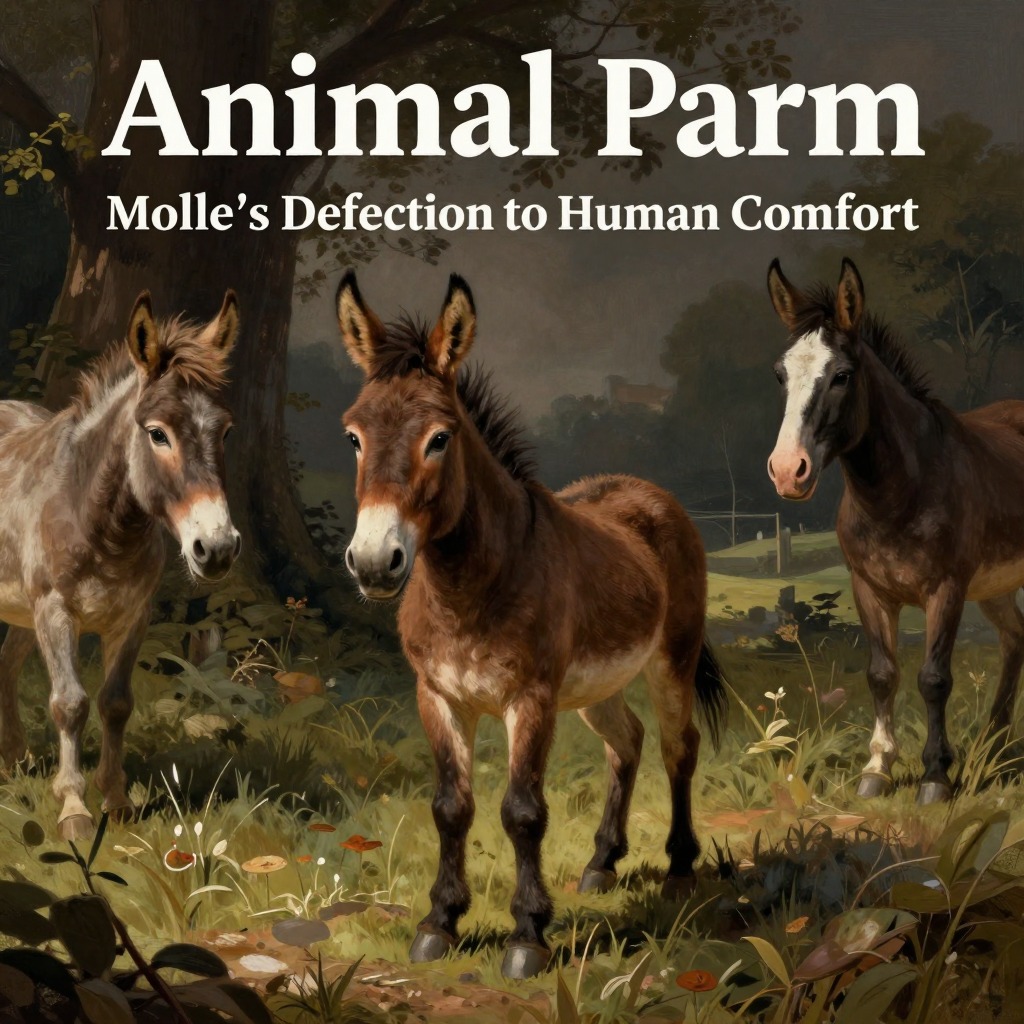
Drinking Pool
The Drinking Pool is a small body of water on Animal Farm, a place that appears repeatedly in the narrative as a setting for private moments and the exposure of individual weaknesses. It is a natural feature of the landscape, part of the farm's geography that the animals come to own after the Rebellion, and it is mentioned alongside other landmarks such as the long pasture, the hayfield, and the spinney. Unlike the farm buildings or the windmill, the Drinking Pool is not a site of collective labor or political assembly; instead, it functions as a space where animals retreat from the communal work and discipline of the farm, and where the tensions between personal desire and revolutionary ideology become visible.
Mollie's Vanity and Defection
The Drinking Pool is most prominently associated with Mollie, the foolish, pretty white mare. As winter drew on after the Rebellion, Mollie became increasingly troublesome, late for work and complaining of mysterious pains. On every kind of pretext she would run away from work and go to the Drinking Pool, where she would stand foolishly gazing at her own reflection in the water. This behavior at the pool reveals her narcissism and her longing for the comforts and adornments of her former life under Mr. Jones—the sugar and ribbons she had asked Snowball about. The pool becomes the stage for her private vanity, a place where she can indulge in the self-regard that the collective ethos of Animal Farm condemns. Her attachment to her own image at the pool foreshadows her eventual defection: she is later discovered to have hidden a stash of sugar and ribbons in her stall, and soon after she disappears, found working for a human publican on the other side of Willingdon, wearing a scarlet ribbon and being fed sugar.
A Site of Mourning and Reflection
Later in the story, after the violent executions of animals accused of collaborating with Snowball, the Drinking Pool appears again as a place of quiet sorrow. The surviving animals, shaken and miserable, make their way to the knoll where the half-finished windmill stands, and from that vantage point they can see the Drinking Pool among the other familiar features of their farm. It is a clear spring evening, and the farm appears to them more desirable than ever, yet Clover's eyes fill with tears as she reflects that this is not what they had aimed for when they set out to overthrow the human race. The Drinking Pool, visible in the peaceful landscape, becomes part of the bitter contrast between the beauty of the farm they own and the terror and slaughter that now define their lives. It is a silent witness to the gap between revolutionary hope and the reality of tyranny.
Daily Life and Hardship
The Drinking Pool is also a part of the animals' daily existence, a source of water for drinking. In the later years of the farm, as conditions deteriorate, the animals' life is described as harsh and bare: they are generally hungry, they sleep on straw, they drink from the pool, and they labor in the fields. The pool, in this context, is a marker of the unvarying, meager routine that has replaced the dreams of plenty. It is a natural resource that, like everything else, is taken for granted, and its presence in the landscape underscores the animals' unchanging physical needs even as the political order around them transforms. The pool is not a place of celebration or innovation; it is a constant, like the hunger and the cold, that the animals endure.
Narrative Significance
The Drinking Pool serves as a counterpoint to the more ideologically charged locations on the farm, such as the Big Barn where meetings are held or the wall where the Seven Commandments are inscribed. It is a space of individual, rather than collective, experience. Mollie's use of the pool to gaze at herself is a direct challenge to the principles of Animalism, which demand that animals work for the common good and reject human vanities. The pool thus becomes a symbol of the personal desires that the revolutionary regime cannot entirely suppress. Later, it is a quiet element in the landscape that the animals see as they mourn, a reminder of the simple, natural world that exists alongside the political horrors they have come to endure. Its recurring presence in the narrative, always in moments of personal weakness or collective grief, marks it as a place where the official story of the farm's success is undermined by the reality of individual unhappiness and loss.